Because the e-rickshaw market is diverse, many parameters vary widely (battery type, motor, payload, manufacturer, region, subsidies). I’ll cover:
- Overview & market context
- Price ranges and factors affecting price
- Key technical specifications & performance parameters
- Major models & their specifications / comparisons
- Total cost of ownership, economics, and return on investment
- Trends, challenges, and future outlook
If you want, I can also prepare a tabular comparison of 10 popular e-rickshaw models in your city (Mumbai) specifically.
1. Overview & Market Context
What is an e-rickshaw?
An e-rickshaw (electric rickshaw) is a three-wheeled electric vehicle (3W) typically used for passenger transport (last-mile connectivity) or light cargo. It replaces the conventional auto-rickshaw driven by petrol / CNG / diesel with an electric drive system (motor + battery). Because of zero local tailpipe emissions, lower operating costs, and increasing EV infrastructure, e-rickshaws have become a popular option in many Indian cities and semi-urban areas.
Unlike full-fledged electric cars or heavy EVs, e-rickshaws are relatively simple mechanically (fewer moving parts), making them suitable for low-cost maintenance and local repair. But their tradeoffs include limited speed, range, challenges in charging infrastructure, and battery degradation.
Market scale & adoption
- According to one source, there are over 300+ e-rickshaw models in India.
- The price of electric auto rickshaws in India is reported to range from Rs 1.00 lakh to Rs 4.50 lakh depending on variant (for “electric auto rickshaw” category).
- Another guide says average electric auto rickshaw prices lie in the ₹1.25 lakh – ₹3.5 lakh band.
- Specialized or premium models (higher range, lithium batteries, advanced features) push the price higher.
- The entry-level or low-spec versions can go as low as ₹0.58 lakh (₹58,000) in some listings (though such ultra-cheap models usually come with tradeoffs in build quality, battery, and service backup).
So, as a prospective buyer or researcher, one must consider that there is no single “typical” e-rickshaw; rather a spectrum from low-end to premium.
Policy support & subsidies
Government policies influence pricing: subsidies (FAME-II, state incentives), tax / registration benefits, lower electricity tariffs, or concessional financing all can reduce the effective cost to the buyer. Some states have favorable policies for EVs (including e-rickshaws). The presence or absence of such support in a particular state can shift the final on-road cost by a significant margin.
2. Price Ranges & Influencing Factors
Typical price bands
Below is a rough categorization of price bands, with pros/cons, and what to expect in each:
| Segment | Approx Price (Ex-Showroom / Base) | Typical Features / Tradeoffs |
|---|---|---|
| Entry / Basic | ₹0.8 lakh – ₹1.25 lakh | Lead-acid battery, lower range (50–80 km), lower motor power, minimal features, limited warranty |
| Mid-range | ₹1.25 lakh – ₹2.25 lakh | Better battery (upgraded lead-acid or entry-level lithium), 80–120 km range or more, more durable build, more reliable service, higher payload |
| Premium / Advanced | ₹2.25 lakh – ₹3.50+ lakh | Lithium-ion battery, higher range (150+ km), enhanced features (better suspension, digital dashboard, comfort, stronger build, better service warranty) |
| Ultra / Specialized / High Range | ₹3.50+ lakh | Very high range (200+ km), advanced battery management, telematics, high durability, brand premium |
One guide states the electric auto rickshaw price in India typically ranges ₹1.25 lakh – ₹3.5 lakh in 2025.
Another listing for specialized models (e.g. Terra Motors) quotes ₹1.20 lakh to ₹1.50 lakh depending on model and features.
Important caveat: These quoted prices often exclude state-level taxes, registration / RTO charges, subsidy offsets, battery replacement cost, etc.
Key factors that influence price
- Battery type, capacity & chemistry
- Lead-acid batteries are cheaper but heavier, with shorter lifespan and range.
- Lithium-ion batteries (LiFePO₄, NCM, etc.) are more expensive but give better energy density, longer life, less maintenance, and better performance.
- The battery capacity (in Ah or kWh) directly affects the range.
- Battery management system, cell quality, thermal management, and warranty also matter.
- Motor power & quality
- Higher power motor yields better acceleration, ability to climb gradients, higher top speed (within permitted limits).
- Motor efficiency, brand (brushless DC, BLDC, PMSM) and build quality (copper windings, insulation) also affect cost.
- Controller, electronics & BMS
- A sophisticated controller (with regenerative braking, differential control, thermal protection) adds to cost.
- Quality wiring, switching devices, safety fuses, diagnostics, digital displays, telematics also add up.
- Frame, body & build quality
- Better materials, corrosion resistance, thicker gauge steel, better welding, better finish, better suspension and shock absorbers — all contribute to higher cost.
- More comfortable seating, design, passenger comfort features.
- Payload, seating & design class
- If intended for cargo or higher passenger capacity, frame and materials must be stronger, adding cost.
- Models with higher GVW (gross vehicle weight) need stronger axles, brakes, etc.
- Range / energy capacity
- Higher range requires more battery, which increases weight, which in turn demands stronger structure and motor.
- After-sales service, spare parts, brand reputation
- Established brands with wider service networks command premium.
- Warranty offers on battery and motor also raise initial cost.
- Taxes, incentives & registration
- State EV policies may waive or reduce registration, road tax, or electricity duties.
- Subsidy under FAME-II may reduce upfront cost.
- Local transportation / permit costs may differ by region.
- Scale / volume & localization
- Mass-produced models tend to be cheaper. Imported or niche models may cost more.
- Value additions like telematics, GPS, IoT features push up cost.
Because of all these variables, two e-rickshaws that look similar might differ by ₹30,000–₹60,000 or more in price.
3. Technical Specifications & Performance Parameters
Below is a detailed breakdown of critical specifications to examine when comparing or evaluating e-rickshaw models.
Key specification categories
- Electric Motor & Drive
- Type: BLDC / brushless DC motor is most common nowadays for efficiency and lower maintenance.
- Nominal Power: Given in kilowatts (kW) or horsepower (hp). Many e-rickshaws use motors in the 1 kW to 3 kW range (or corresponding hp) for city speeds.
- Peak / Surge Power: Sometimes higher for short bursts (useful for hill climbs).
- Torque: Important for acceleration and hill climbing (measured in Nm).
- Drive arrangement: Rear-wheel drive (usually) or sometimes mid-drive; may include differential or direct drive.
- Gear reduction: Some have gear or reduction units; others have direct drive.
- Battery System
- Rated Voltage: Commonly 48V, 60V, 72V or more.
- Capacity: Expressed in Ah (amp-hour) or Wh / kWh. E.g. 130 Ah at 48 V ~ 6.24 kWh.
- Chemistry: Lead-acid (cheapest), sealed lead-acid (SLA/VRLA), lithium-ion (LiFePO₄, NMC, etc.).
- BMS (Battery Management System): For cell balancing, overcharge, over-discharge protection, temperature management.
- Charging time: Time to full charge under normal charger (say 8–10 hours), and fast charging capability, if any.
- Battery life / cycle durability: Number of charge-discharge cycles (e.g. 800–1500 cycles for Li-ion, less for lead-acid).
- Recharge efficiency / losses: Efficiency losses in charging/discharging (typically 85-95%).
- Performance (Range, Speed, Efficiency)
- Top Speed: Usually limited, e.g. 22–30 km/h in many models for regulatory / safety limits.
- Example: The Mini Metro e-rickshaw has top speed 22 km/h.
- Range per charge: How many kilometers one can travel under typical load/conditions. Many models quote 80–120 km; premium ones 150+ km or more.
- For example, the “ideal” e-rickshaw has range 80–100 km per charge in many city conditions. zero21.autos
- Gradeability / Climbing Ability: How steep a slope (in percentage) the vehicle can climb while loaded (e.g. 10%, 15%, 20%).
- Load Efficiency / Energy Consumption: Wh per km or km per kWh.
- Regenerative braking: Some advanced models recover energy when braking.
- Top Speed: Usually limited, e.g. 22–30 km/h in many models for regulatory / safety limits.
- Chassis, Suspension & Body
- Frame & Material: Steel tubular / boxed frame; material thickness, corrosion protection.
- Suspension: Usually independent or leaf spring in front / rear; shock absorbers to handle ride comfort.
- Brakes: Drum, disc or hydraulic brakes; front & rear; parking brake.
- Wheel & Tyres: Size (e.g. 4.00-8, 4.50-10 etc), tyre type (tubed/tubeless), tyre width.
- Steering: Steering mechanism (handlebar, steering column), turning radius. E.g. Mini Metro e-rickshaw turning radius ~2200 mm.
- Body / Roof / Cover / Doors: Some have open / half body / full body covers; materials like fiber, sheet metal, etc.
- Seating / Passenger comfort: Cushioning, space, legroom, backrest, footrest.
- Safety features: Lights, indicators, horn, speed limitation, reflectors, structural safety, over-load protection.
- Dimensions, Weight & Payload
- Dimensions: Length, width, height — important for maneuverability and road compatibility.
- Kerb Weight / Curb Weight: Weight of the vehicle without payload / passengers.
- Gross Vehicle Weight (GVW): Maximum allowed total (vehicle + payload + passengers).
- Payload / Load Capacity: Maximum cargo / passenger load the vehicle can legally and safely carry.
- Weight distribution: How weight is distributed (especially battery location) affects handling.
- Electrical & Auxiliary Systems
- Controller: Ampere rating, control strategy, heat dissipation.
- Wiring, fuses, safety circuits
- Dashboard / Instrumentation: Analog / digital speedometer, battery status indicator, odometer, fault codes.
- Lighting / Illumination: Headlights, tail lights, brake lights, indicators, interior lights.
- Other amenities: USB charging port, mobile holder, music / horn, fans/ventilation.
- Telematics / IoT / Remote monitoring: Advanced models may include GPS, remote diagnostics, battery health tracking, mobile app integration.
- Warranty, Service & Parts
- Warranty on battery, motor & electronics
- Spare parts availability
- Service network / authorized repair centers
- Maintenance schedule & costs
4. Major Models & Comparative Specifications
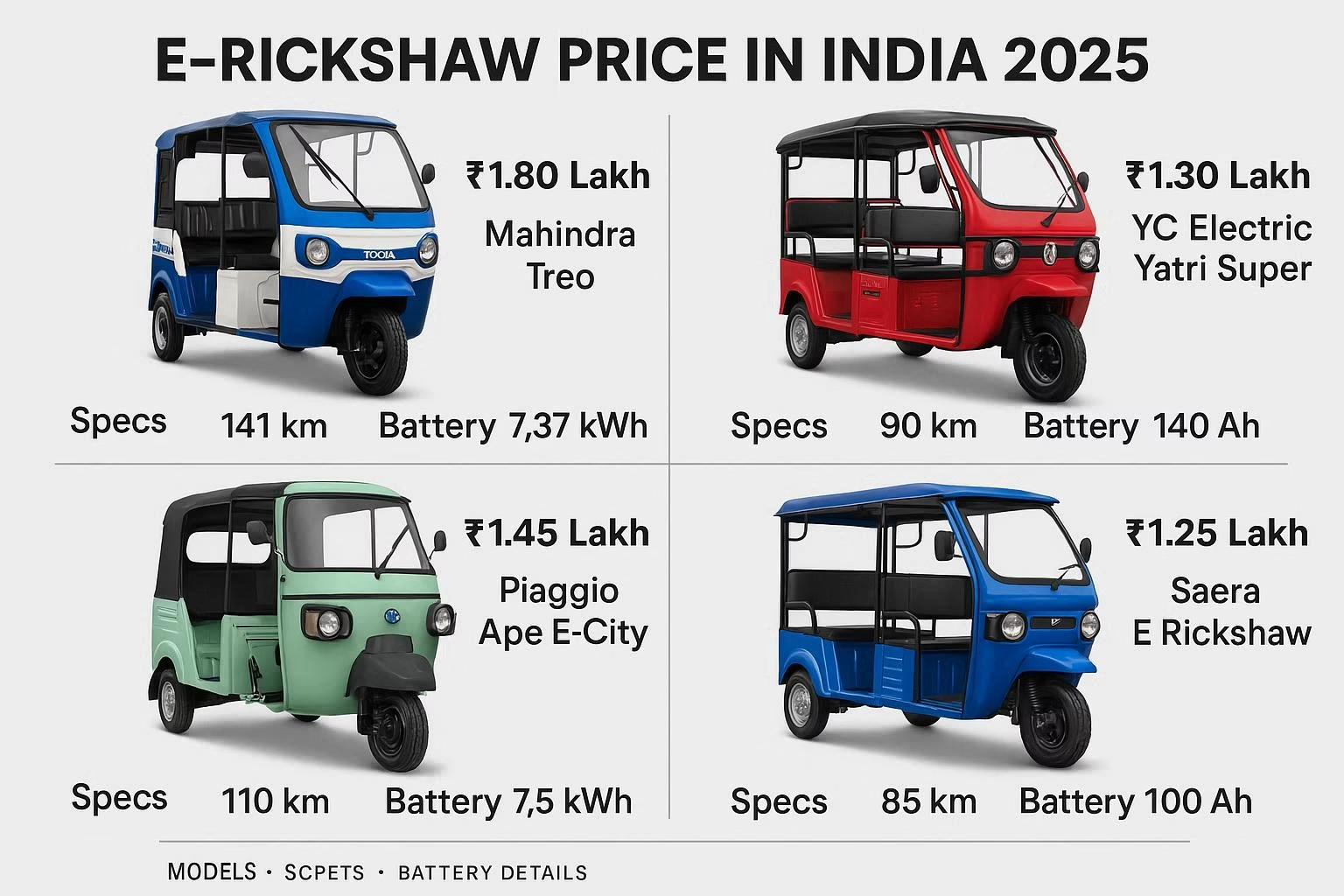
Here are a few representative e-rickshaw / electric auto / 3-wheeler models currently in the Indian market (or upcoming), along with their published specs and pricing. This helps ground the theoretical in real-world examples.
4.1 Mini Metro E Rickshaw
- Price: ₹1.55 lakh (ex-showroom, Agra) for the 4-seater model (GVW 500 kg)
- Specifications:
- Top speed: 22 km/h .
- Range: ~110 km on full charge
- Battery: 130 Ah (type not specified).
- Turning radius: ~2200 mm.
- Motor: BLDC motor (specs not fully disclosed) .
- Charging time: ~8 hours (typical).
This is a fairly common lower-mid segment model.
4.2 Mahindra Treo Yaari
- Price: In some listings, ₹1.96 lakh to ₹2.04 lakh range (for the electric auto version.
- Payload / Loading: The payload is about 550 kg.
- Other notes: It competes in the electric three-wheeler (auto) space with better brand backing and service network.
However, note: Mahindra Treo is more in the “auto 3W / electric auto / last-mile vehicle” class than the simplest e-rickshaw, so some features (speed, range) may be higher.
4.3 Astro Nova Electric Auto Rickshaw
- Battery Capacity: 10.24 kWh.
- Range: ~218 km per charge.
- Top Speed: 55 km/h.
- Payload: 435 kg.
- Price: Though not explicitly fixed in the listing, the model is positioned in the electric rickshaw market in India; typical pricing for similar models is ₹1.5–₹3.5 lakh.
This is a more advanced / higher performance model, bridging the gap toward “electric auto” class.
4.4 Piaggio Ape E City FX Max (Electric Auto Rickshaw)
- Price: ₹3.25 lakh to ₹3.30 lakh (quoted).
- Range: 140–150 km per charge.
- Battery / Charging: Battery capacity ~8 kWh (approx).
- Gradeability / Slope Handling: ~20% gradeability.
This is more toward the “electric auto / high-performance 3W” class.
4.5 Other Listings from Trade / Manufacturers
- TradeIndia lists a number of e-rickshaw models from various manufacturers, e.g. “Ms Model Baba E Rickshaw” with battery capacity 130 Ah, price ~ ₹113,500 (i.e. ₹1.135 lakh) as a quoted price for wholesale / OEM listing.
- Kuku Automotives (manufacturer) lists an “electric auto rickshaw” at ~ ₹1,64,000 (battery-operated) for one of their models.
These listings show how a given manufacturer positions its pricing given battery, build, intended usage, etc.
5. Total Cost of Ownership (TCO), Cash Flow, and Profitability
When evaluating an e-rickshaw, it is not enough to look only at the buying price. The total lifecycle cost will determine viability. Key components:
Operating Costs
- Electricity / Charging Cost
- Suppose the e-rickshaw consumes ~60 Wh/km (just as an example). For 100 km, that’s 6 kWh.
- If electricity costs ₹8 per kWh (this depends on local tariff, off-peak rates, etc.), the cost = 6 × 8 = ₹48 for 100 km.
- Even with a higher consumption or higher tariff, the cost per km is typically much lower than petrol / diesel / CNG.
- Maintenance & Repairs
- Fewer moving parts compared to ICE (internal combustion engine) – no oil changes, fewer mechanical parts. But wheel bearings, suspension, brake maintenance, battery health, wiring, etc. still incur cost.
- Battery replacement is a major expense (if battery degrades after e.g. 5–7 years or sooner).
- Tire, brake, frame maintenance, bodywork, etc.
- Depreciation
- The residual value (especially battery) matters. Over time, battery capacity declines, which reduces range and usability.
- The brand, service, and ability to refurbish or recycle the battery affect resale value.
- Downtime / Charging time
- Time spent charging instead of running means less earning potential. Fast charging or swappable battery systems can reduce downtime, but these typically cost more.
- If the vehicle must rest for long periods due to battery recharge time, that impacts utilization.
- Permits, Insurance, Registration Costs
- Insurance premium, annual registration / road tax (if applicable), permit fees (if carrying passengers), local levies.
- Financing cost
- If the purchase was financed (loan / EMI), interest adds cost.
- The down payment, tenure, rate of interest will influence cash flows.
Earnings / Revenue
- Daily revenue depends on route length, passenger demand, fare structure, and utilization (km driven per day).
- After deducting operating cost, net daily margin = revenue – electricity – maintenance – financing cost – other overheads.
Example rough calculation (simplified):
Assume:
- Purchase cost (ex-showroom): ₹1,50,000
- Battery plus component life: 5–7 years
- Daily distance: 100 km
- Electricity cost: ₹8 per kWh
- Consumption: 60 Wh/km = 0.06 kWh per km
- Daily electricity usage: 100 × 0.06 = 6 kWh → cost ₹48
- Maintenance & miscellaneous: say ₹25–₹50 per day
- Financing cost (if loan): say EMI adds ₹80 per day (depending on loan terms)
- Total daily cost ~ ₹48 + ₹40 + ₹80 = ₹168
- Suppose daily revenue = ₹400 (just an illustration)
- Net before depreciation = ₹232 per day
- Annually (300 working days) net ~ ₹69,600
- Battery replacement / depreciation cost may be amortized over years.
You’d compare net earnings vs initial investment to see payback period.
Hence, even if the upfront cost is higher, lower running cost and maintenance may make e-rickshaws more economical over a 5–7 year horizon compared to conventional autos.
6. Challenges, Trends & Future Outlook
Challenges / Constraints
- Battery degradation & replacement cost
- Over time the battery loses capacity, reducing range. The cost to replace can be high.
- If battery fails prematurely, that hurts the business.
- Charging infrastructure / grid reliability
- Availability of reliable charging stations or dedicated charging infrastructure is essential.
- In areas with power cuts or weak grid, charging is a challenge.
- Load & uphill performance
- On steep roads or when heavily loaded, performance can drop. Some models struggle with gradients if underpowered.
- Quality / safety / regulation adherence
- Some low-cost / unbranded models may skimp on safety standards, wiring, brake, structural integrity.
- Overloading, lack of proper registration or permits, or neglect of regulations is a concern.
- Battery supply / cell sourcing / cost volatility
- The cost of battery cells, raw materials (lithium, cobalt, etc.) can fluctuate.
- Service / parts availability / after-sales network
- In many smaller cities, getting service support or spare parts may be a challenge.
- Competition from other modes / electrification of 4W / better EVs
- As electric cars, e-scooters, etc. improve, and as public transport improves, competition increases.
- Policy / subsidy uncertainty
- Changes in government support / subsidies or regulatory changes can affect viability.